The Rise of Specialized Operating Partners in Private Markets
Executive Summary
Private markets are undergoing a quiet shift.
For years, value creation followed a relatively predictable model. Portfolio companies relied on a trusted network of operating partners, advisors, and consultants to support growth, transformation, and post-investment execution.
The model worked because many challenges were broad in nature. An experienced operator could often be deployed across multiple situations with reasonable success.
Today, that assumption is becoming harder to sustain.
Portfolio challenges are becoming increasingly specialized. AI implementation, GCC buildouts, pricing transformation, operating model redesign, enterprise modernization, and post-merger integration often require highly specific execution capability rather than generalized operating support.
The shift is not replacing traditional operating partner networks.
It is changing how they are deployed.
Observation 1: Execution Is Fragmenting
Historically, many operating partner models were built around broad operational leadership.
Today's portfolio challenges increasingly sit at the intersection of technology, operations, transformation, and scale.
A GCC buildout requires a different operating profile than a pricing transformation. An AI modernization initiative demands different capabilities than a post-acquisition integration.
What appears to be a single transformation mandate often contains multiple execution challenges underneath.
As a result, investors are increasingly looking beyond general operating experience and toward operators with direct experience solving specific categories of problems.
Across the Operatif ecosystem, capability concentration is increasingly centered around execution-oriented mandates:
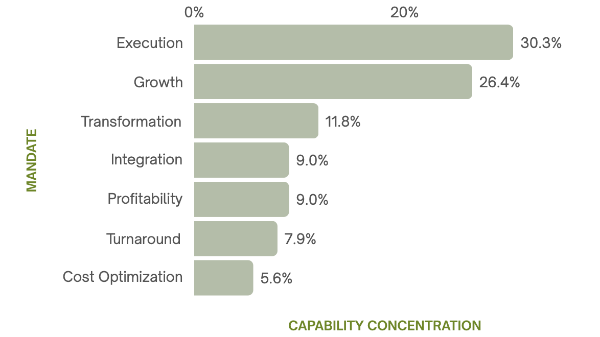
The distribution itself is less important than what it signals.
Execution capability is becoming a more important value creation lever than it was a decade ago.
Observation 2: The Rise of Hybrid Operators
A second trend emerging across private markets is the rise of hybrid operating profiles.
Many operators no longer fit neatly into traditional categories.
Across the Operatif ecosystem, recurring backgrounds increasingly include:
Former consultants who transitioned into execution leadership
Operators with direct P&L ownership across scaling environments
Transformation leaders with enterprise modernization experience
Executives spanning commercial, operational, and technology functions
These are not purely advisory profiles.
They are operators who have led change directly, often across multiple dimensions simultaneously.
That distinction matters because portfolio companies today are rarely dealing with isolated strategic questions. More often, they are navigating environments where teams, systems, technology, governance, and operating cadence all need to evolve together.
Observation 3: GCCs Illustrate the Shift
One of the clearest examples of this evolution is emerging around Global Capability Centers.
For years, GCC conversations were primarily associated with labor arbitrage and offshore delivery.
Today, many GCC environments have become strategic execution platforms supporting AI engineering, analytics, cybersecurity, product development, and enterprise transformation.
Across operator profiles within the Operatif ecosystem, GCC initiatives frequently began as cost-efficiency programs but evolved into significantly broader transformation mandates.
Building and scaling a modern GCC is no longer simply a hiring exercise.
It increasingly requires operators capable of navigating enterprise transformation, digital execution, organizational scaling, and cross-border complexity simultaneously.
The GCC story is ultimately a broader story about specialization.
What This Means
For investors, the challenge is increasingly becoming diagnostic rather than access-driven.
The question is no longer whether experienced operators exist.
The question is whether the right operator can be identified and deployed against the specific execution challenge a portfolio company is facing.
For operators, the implication is equally important.
Demonstrated outcomes are becoming more valuable than functional titles alone. Deep experience in solving specific transformation, growth, profitability, or execution challenges is increasingly becoming a differentiator.
Operatif Perspective
Private markets will always remain relationship-driven.
Trust remains fundamental to how investors deploy operating partners within portfolio environments.
But as execution complexity continues to fragment, the advantage may increasingly shift toward those who can combine trusted networks with structured capability intelligence.
The challenge is no longer access to operators. It is diagnosis.
Because the next phase of value creation may depend less on finding an operator and more on identifying the operator who has already solved that exact situation before.
About Operatif
Operatif helps investors, portfolio companies, and enterprises identify operators who have previously solved specific value creation challenges across growth, transformation, profitability, integration, and execution mandates.